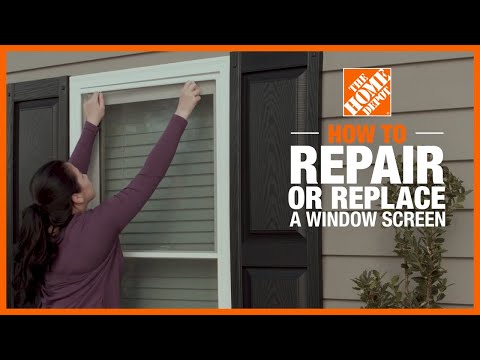
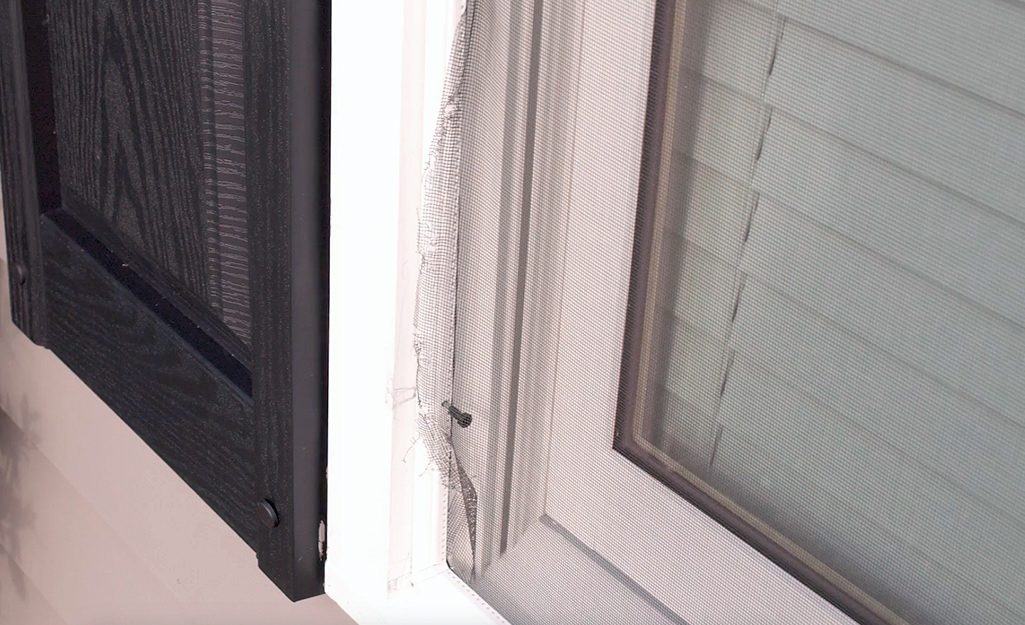
Window screens are an effective, simple way to keep bugs and pests out of the home while inviting fresh air indoors. Plus, screens can help filter sun and dampen outside noise. Unfortunately, the screens or their frames can be damaged easily. Wood window frames can shrink, while vinyl or aluminum window frames can warp, causing the screen joints to loosen and the screen mesh to sag.
Minor holes and tears in the window screen mesh are also common problems. Use screen repair tools like adhesive, spline rollers and pre-manufactured patches to patch a window screen in three easy steps. This guide will teach you how to replace and repair your window screens.
Tip: Retain the bent, old screen spline if it’s flexible and can be shifted back into place. If not, purchase a new window screen spline for a longer-lasting window frame repair. Jump to Specific Section
How to Replace a Window Screen
Severe damage to your window screen is a clear sign that you need to replace them. Screens with large holes and rips should be replaced, not patched. If your screen mesh is shiny, rather than dark and matte, or you’re noticing more outside noise than usual, these are also signs that the mesh is old and worn and should be replaced.
Replacing window screens will improve both the look and security of your home. The steps to learn how to replace window screen mesh are similar for both wood windows and aluminum windows.
Tip: If the window is difficult to open and close, the window screen’s frame may be bent out of place. In this case, you may need to replace the frame as well as the screen mesh with a pre-framed window screen.
Remove Damaged Screen Mesh
Remove the screen from the window and lay it on a flat work surface.
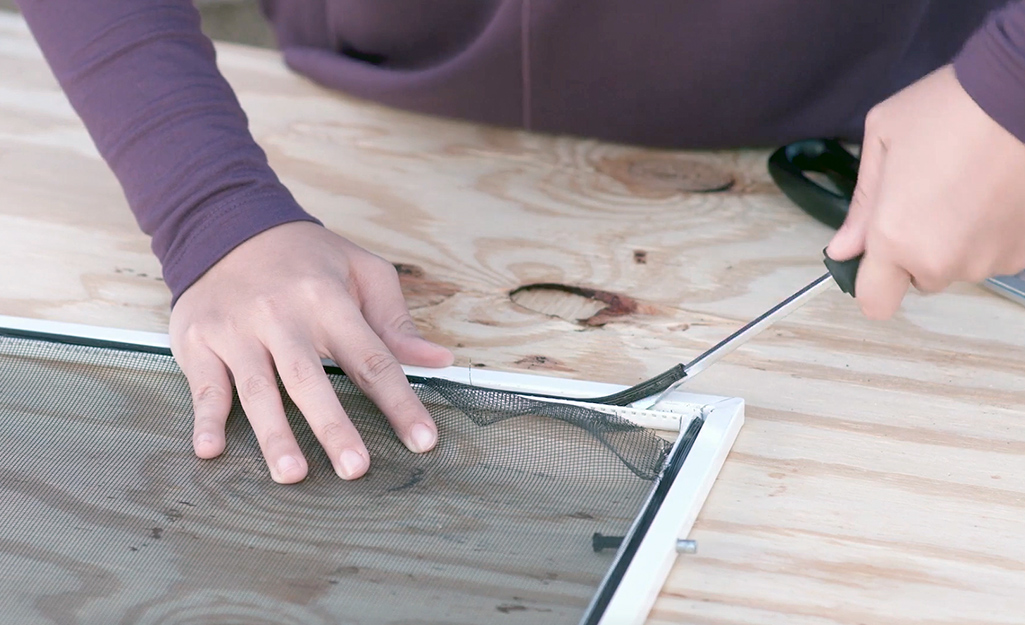
Using a slotted or flathead screwdriver, pry the window screen spline from the grooves around the edge of the frame.
Wooden screen frames may use staples or nails to hold the mesh in place. Pry out the staples using a staple remover or your screwdriver. Use a claw hammer to remove nails.
Remove and dispose of the damaged screen mesh.
Stretch and Cut New Screen Mesh
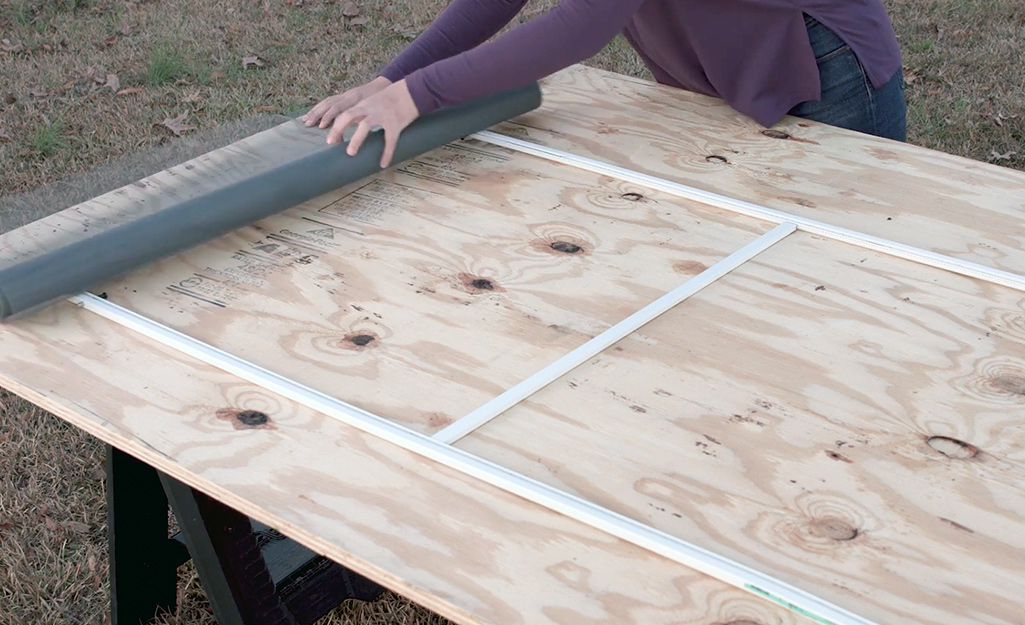
Roll out and stretch a new roll of screen over the window frame, pulling it so that it overlaps the frame’s retaining grooves.
Leave extra screen overhanging the frame so you can secure it tightly in the next step.
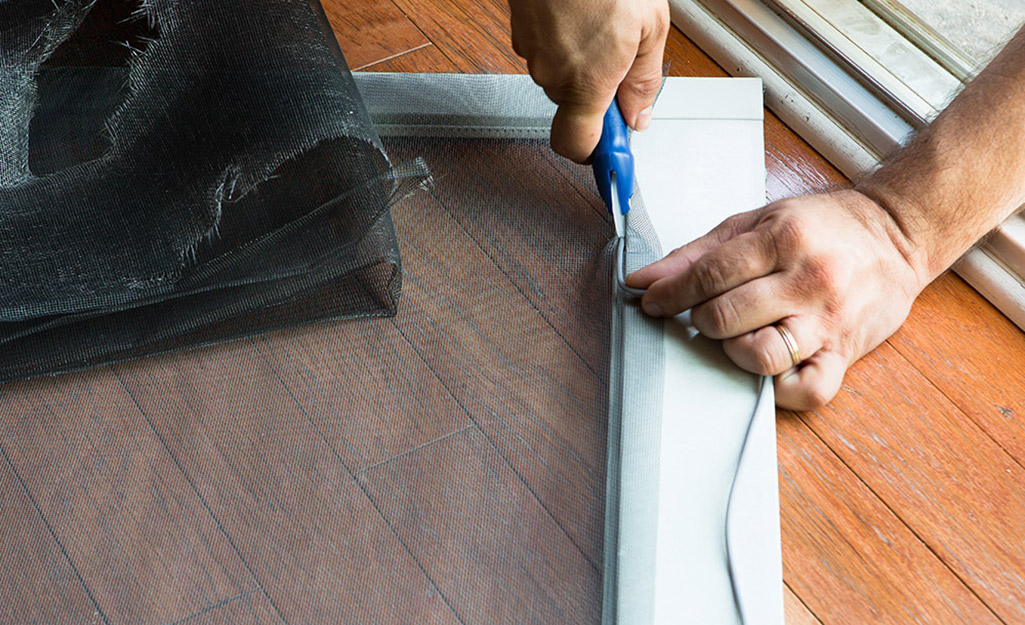
Cut the screen using scissors.
Tip: You may need another person to help you hold the screen mesh in place while you cut.
Secure Screen Mesh
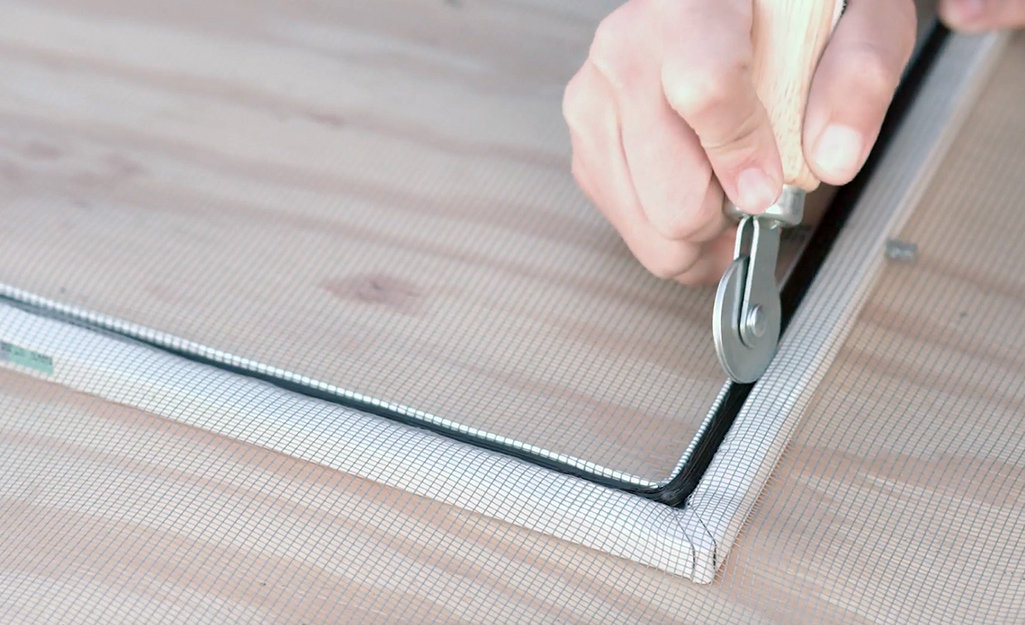
Use a spline roller to press the spline and screen into the frame’s retaining grooves.
For a wooden screen frame, staple the mesh into place or nail it into place with wire brads.
Once secured, the mesh should be taut, but not over-stretched, across the frame.
Trim Excess Screen Mesh
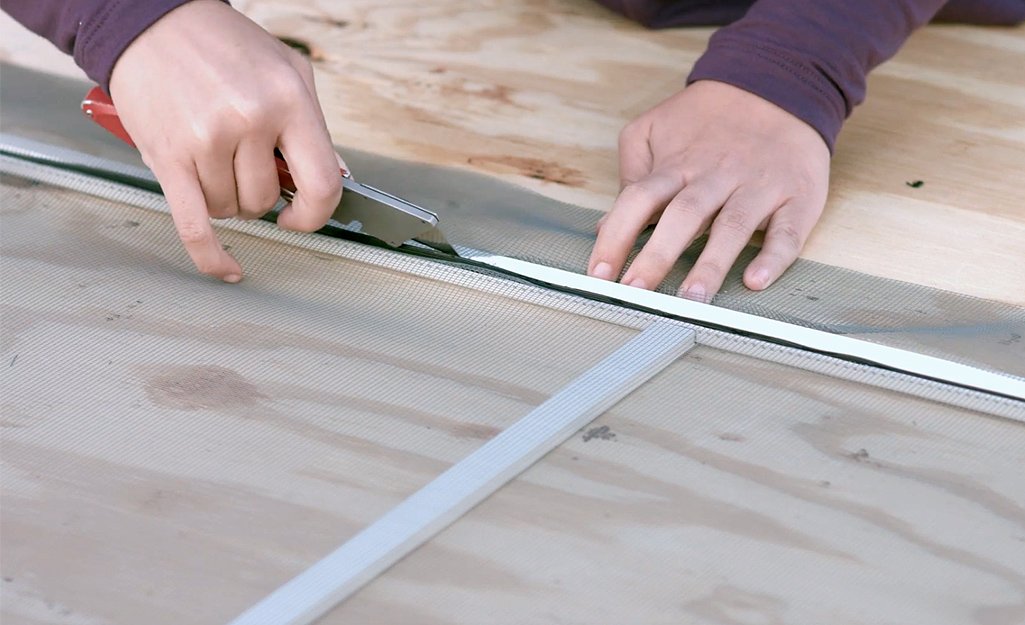
After securing all four sides of the mesh, trim away the extra material using a utility knife or scissors.
Take care not to cut into the spline.
Tip: Now’s a good time to reinforce any loose joints on wooden frames with fasteners, angle plates or screws.
Replace Screen
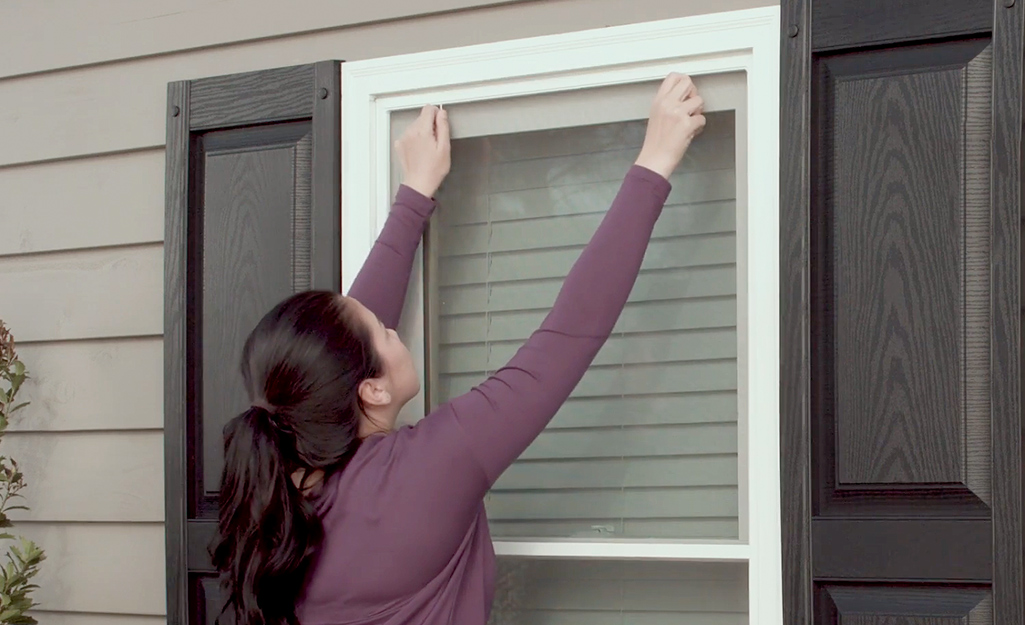
Reinstall the completed window screen to your window.
How to Repair a Window Screen
Minor holes and tears in window screening are easily fixed with glue and pre-manufactured patches. You usually won’t have to remove the window screen unit to make the repair.
Measure: Big holes in window screens are much harder to repair. Measure your patch to ensure it can be repaired effectively and will not affect the functionality or appearance of the window screen.
Cut the hole: Cut the screen’s hole into a neat square. Bend the edges of the hole so that the cut ends of the mesh will penetrate the patch.
Cut a patch from screening mesh: Using your measurements, cut a mesh patch that is about 1/2-inch bigger than the hole on every side. If you’re using a patch kit, use one of the pre-cut patches or cut it to size as needed.
Affix patch over hole: Place the screen patch over the hole in the plastic or fiberglass screen. The hole needs to be completely covered. While wearing work gloves, press the bent edges of the screen hole flat, so it holds the patch in place.
Secure patch: The edges of the patch should be secured with waterproof glue used sparingly. Wipe away any drips before the glue hardens. A fiberglass screen can also be fixed by sewing a patch over the hole and then securing with glue.
Tip: Tiny holes in window screens can be fixed without a patch. Use waterproof instant adhesive to close a hole in nylon or fiberglass screens. Use epoxy to repair a small hole in metal screens.
Repair or replace your window screens to enjoy the fresh air again without the intrusion of pests. When an adhesive or patch won’t suffice, replacing a window screen completely is the most cost-effective and attractive solution. For more complex problems, use The Home Depot to find a professional in your area that can provide window and door screen repair solutions.
When it’s the middle of winter and freezing outside, it’s probably safe to say that most of us aren’t thinking about our ceiling fans. However, running fans in the colder months can actually save up to 10% on heating costs and is as simple as flipping a switch.
In the summer months, the slightly angled blades of a ceiling fan turn counterclockwise to move air down, making people feel cooler due to a concept known as the wind chill effect. During winter, the warm air generated by your heating system naturally rises to the ceiling while cooler air sinks. By switching the direction that your fan blades turn, that cooler air is drawn upwards, which forces the warmer air near the ceiling back down into the space.
How does this save energy?
Since thermostats are typically located at a human level, keeping the warm air low where it’s needed means you can turn the temperature down a few notches and still stay warm.
On most fan models, there is generally a small switch on the fan to reverse the direction (I actually had to remove a few screws to reach ours). Additionally, running the fan at the lowest speed will circulate air while reducing the feeling of actual air movement in the room. While this technique should work in standard-size rooms, it works especially well in vaulted or tall ceiling spaces where the people occupying the space are further separated from the warm air collecting at the ceiling. Furthermore, even though running a fan uses a small amount of electricity, there is generally still a net saving in energy use.
The heater in your home is an essential part of both comfort and safety. Protecting the home from extreme cold temperatures in the winter months is something all homes should b equipped for. Of course, heaters are like any home appliance; they still need the occasional inspection and maintenance. Heaters need to be kept clean, internally and externally, and many types of heaters need to be monitored to ensure they remain safe inside the home.
It’s important for your heater to be in top condition before the cold season blows in each year, but how often is really practical to get your heater inspected? No doubt, you’ve heard everything from “inspect twice a year like clockwork” to “Our heater’s been fine un-inspected for decades.” What is the right frequency of inspections to keep your home safe without going over the top?
Today, we’re here to help with more than a few tips on timing your heater inspections for the best value to the home.
How Often Should Your Heater Be Inspected?
Twice a Year
Annually
Every 2-5 Years
Break-Fix Repairs
How frequent should heater inspection be for your home? It depends on a few varying factors. If your home uses heat a great deal, relies on heat heavily in the winter, or has a finicky heater design – then an inspection every 6 months is not out of the question. Just like going to the dentist so frequently, this preventative work will ensure that any to all problems are caught early and prevented.
For most people, we would broadly recommend annual heater inspections, timed during the early autumn or late spring. Annual heater inspections ensure that your heater is in good condition from year to year and that you never go longer than a year without discovering a lurking problem. It is also a responsible way to own a heater, either warming it up or putting it away each year.
Climate and Importance of the Heater
How often your heater needs to be inspected is also influenced by climate. The amount of use, stress, and importance of your heater during the cold months of the year.
Cold Winters: Inspect Every 6-12 Months
In regions where it snows inches to feet every year, and annual winter storms are the norm, heaters are a vital piece of household equipment. You want your heater inspected at least once a year, maybe twice a year, to ensure the heater is in good condition when you need it – every time you need it.
Mild Winters: Inspect Annually
If you see frost every winter, the heater is still important for keeping the family safe during the yearly freeze. For furnaces, gas heaters, and boilers – common in these regions – you will want an annual inspection with maintenance. This ensures your heater is in good shape and ready to fire back up. Some small malfunctions like a clogged flue or loose seal can be dangerous to the entire house.
An annual inspection ensures your heater is safe to use and/or safe to put away every year.
No Winter: Inspect Every 2-5 Years
Homes in warm climates that see very little winter have homes designed for less heater use. The home HVAC usually features electric-only heaters, and the heaters sometimes aren’t used at all in a year. In these climates, you should schedule an inspection every two to five years – whether it seems like you need it or not.
In this case, the inspection ensures your filter is clean, your wires are aging well, and there’s not too much dust in the system before you fire it up for a cold winter.
The Type of Heater in Your Home
Some heaters need more maintenance than others. Boilers, gas heaters, and furnaces are all potentially dangerous if poorly maintained, and therefore should be inspected regularly to make sure they are still safe to run. Lying dormant during the summer may allow a heater to fall into disrepair, as can constant use during the winter.
Electric heaters require less maintenance as they do not use volatile materials, but still need to be inspected periodically to clear dust, check fans, and ensure the quality of the wires and elements inside.
Seasonal Safe Maintenance
Before Switching the Heater Each Year
You know the burning-dust smell when you turn on the heater for the first time every year? That’s the mildest possible problem that the first heat-up can cause. Clogged flues, gad and pilot light issues, sediment in your boiler, and frayed wires can all potentially cause disaster in the first cold month of the year.
Getting an inspection before your first use of the heater is a smart move to ensure safety, and that heat will be there when you need it.
Before Shutting Down the Heater in Spring
Some types of heater (and older heaters) should be shut down and maintained at the end of each cold season. Your furnace can be cleaned out, checked, and closed for the summer so that it’s ready to go again next fall. Boilers can be cleared of debris and oil buildup before sitting unused for months. Old appliances can be checked to see if the winter season did any wear-and-tear damage.
Make Use of a Warranty
Often, heater installations come with a handy warranty. The warranty may just be for product quality, but it might include discounted or complimentary maintenance for the first few years of ownership. If you have a warranty for maintenance, make use of it. Your HVAC pros make these offers for a reason – to give you the best possible heater performance and extend the overall lifespan of the heater with good early maintenance.
Dual-Purpose AC and Heater Inspections
Last but not least, remember that your heater inspections can be a full-service HVAC inspection and maintenance visits. HVAC inspections in the spring can get your AC ready for summer and put your heater away after a winter of hard work. Inspections in the fall can make sure your AC is in good shape after a hot summer and prepare your heater to fire up before the first truly cold night of the year.
How frequently should you have a heater inspected? The best answer is about once a year, no matter what climate you live in. This ensures that no issues are overlooked for longer than a year. If you have extreme weather or a high-maintenance heating system, schedule twice a year inspections instead. Time your one or two visits with the most important season for your home – either before the winter chill or before the summer heat.
Nothing beats enjoying your fireplace on a cold winter night. It’ll keep you warm and looks stunningly beautiful. However, if you don’t follow a few chimney maintenance tips, it might not be safe to use your fireplace.
Maintaining your fireplace and chimney is crucial to keeping your home safe when using your fireplace. Without proper attention and cleaning, you’re susceptible to fires and water damage. Plus, you can save money on your energy bills.
These 8 chimney maintenance tips will help ensure that your fireplace and chimney are well taken care of and working properly. Don’t worry about anything because Vertical Chimney Care is here to help!
1. Have a Functioning Fireplace Damper
Your fireplace damper makes a huge difference in your home’s energy efficiency. When you’re not using your fireplace, the dampers should be closed to keep outside drafts from getting into your home through the chimney.
If your damper isn’t closing, it’s going to reflect on your energy bills. It’ll be much harder for your furnace or air conditioner to achieve your desired temperature because they’ll constantly be in battle with the drafts. They’ll end up using more power to heat or cool your home and the price of your electric and heating bills will skyrocket.
When you use your fireplace, the dampers need to be open. If your dampers are broken and can’t open, you can’t use your fireplace. The damper will trap the smoke in your home causing you to breathe in carbon monoxide which is very bad for your health.
Having your dampers fixed or replaced when they’re not working properly is crucial. When getting a replacement fireplace damper, make sure it fits properly – it must be snug and not have any gaps.
2. Make Sure your Chimney is Waterproof
Moisture and the elements can be major problems for your chimney. They can weaken the structural integrity of your chimney, cause mold and even damage the walls and floor around your fireplace. You’ll need to make sure your chimney waterproofing, chase cover, crown and flashing are all functioning properly.
Start by waterproofing your chimney. Adding a water sealant to the outside of your chimney will prevent moisture from breaking down the bricks and mortar and sneaking into you home.
Obviously there’s a large hole at the top of your chimney which allows smoke to escape. You don’t want to seal that hole but you also don’t want rain and snow from getting into your home. What can you do?
For prefabricated chimneys, chase covers are a great addition. It covers the top while still allowing smoke to escape through a small pipe. Most prefabricated chimneys come with galvanized steel chase covers which have a tendency to rust. Replace it with a stainless steel, copper or aluminum chase cover so you don’t have to worry about rust again.
For masonry chimneys, you’ll need to get a crown. It’s a concrete cover that prevents anything from getting into your home. Like chase covers, the smoke escapes through a pipe coming from the crown.
The flashing is where the chimney meets the roof. Without a sealant going around the meeting point, moisture can seep into your home. Make sure your flashing is in good condition.
3. Know When to Have Your Chimney Swept
No matter what type of fireplace you have, you’ll need your chimney swept in order to keep your home safe. The question is, how often do you need a chimney sweeping?
While there’s no specific amount of time to get your chimney cleaned, there are a few things to consider. The amount you use your fireplace will determine how often you have your chimney swept. Once the chimney liner has 1/8″ of soot, it needs to be cleaned.
If you’re not sure how to measure soot, there’s an easy metric you can use – your chimney should be cleaned every 50 burns. This differs from the type of fireplace you have. For instance, a gas log fireplace needs to be swept less often than a wood burning fireplace. About 50 burns is a good place to start.
4. Gas Log Fireplaces Are Better for Your Chimney Than Wood Burning Ones
This is one of the more unique chimney maintenance tips. Replacing a wood burning fireplace with a gas log fireplace could be safer for your home. Gas logs burn much greener than real logs – they produce a less harmful smoke and are extremely energy efficient. In fact, they have a 92%-99% efficiency rating vs the typical 60%-80%.
Not only is that safer for the efficiency, but it’s safe for you. Since the gas log fireplace is burning up to 99% of the gas used, there’s less soot in your chimney. That means you can go longer between chimney sweeps and you’re less at risk of fires.
Don’t think you’re sacrificing beauty for efficiency. For a time, gas log fireplaces lacked the elegance of a wood burning fireplace, but things have changed. Now, the hand painted, ceramic gas logs are made to look identical wood logs.
5. Make Sure Your Mortar Joints and Bricks Aren’t Crumbling
The bricks and mortar joints of your chimney play a crucial role in avoiding water damage inside of your home. However, they begin to crack and crumble over time and give moisture an entrance into your home.
Chimney tuckpointing is the act of repairing mortar. If you notice that your mortar is crumbling and the bricks are starting to become loose, then you’re in need of chimney tuckpointing.
Make sure you get a waterproofing sealant for your chimney stack. This will help keep the mortar and bricks protected from moisture.
6. Have Your Chimney Inspected Once Per Year
Just looking at your chimney isn’t enough to spot problems – some are underlying and need a professional to find them. Having a chimney inspection once per year is crucial to ensure your chimney’s safety.
There are three levels of chimney inspection to consider:
Level 1: used for chimneys that seem to be functioning properly. Examines all readily accessible portions
Level 2: best for homes that are changing how they use their chimney or the heating source. Required before selling a property. Includes everything in a level 1 plus attic, crawlspace and exterior inspections
Level 3: most in depth inspection. Includes everything in inspection 1 and 2 plus checking more concealed areas. This inspection is for chimneys where there’s a major problem that needs to be addressed
These Chimney Maintenance Tips Will Save You Money and Keep Your Home Safe
There are many different chimney and home maintenance tips but these are our 6 favorites. They cover everything from minor chimney inspections to completely changing how you use your fireplace.
If you own and operate any type of fireplace, you must practice frequent chimney maintenance. Like motor vehicles, both fireplace and appliance utility flues routinely need servicing over their lifespan. While we would all like to avoid the expense and hassle, maintenance on your chimney is inevitable and imperative. Failure to do so puts your system, home, and family at risk. This blog post will set you and your heating systems up for success by answering the most notable chimney maintenance frequently asked questions.
People often look for the cheapest and most convenient options available. Of course, that can sometimes work effectively with regular upkeep or minor repairs; however, sufficient knowledge and skills aren’t nearly as readily available when it comes to the inner workings of fireplace systems. That’s why you must choose Certified Professionals and we’re here to help.
The most essential way to maintain your chimneys is by having them inspected at least once per year. If you’ve recently purchased a new stainless steel liner system, then it likely comes with a warranty. Depending on the manufacturer, a chimney liner warranty could be 10-20 years.
At Full Service, our stainless steel liner systems are under a lifetime warranty with professional installation. An annual inspection is a requirement to fulfill the liner warranty claims if needed.
How Often Does Your Fireplace Need Maintenance
A fireplace and its chimney flue need swept and inspected at least once per year. Please keep in mind that this is only the minimum recommendation for the proper upkeep of your burning system, no matter what type of fuel you use (gas or wood). It’s also true for any gas appliance that has a flue pipe which also requires regular maintenance for performance and safety.
Other systems that need annual cleaning are gas furnaces or water heaters, and wood stoves. The same is true for oil burners, but we don’t see too many of those in our Midwestern area!
How Can I Tell if My Chimney Needs Cleaning?
Suppose your fireplace is experiencing poor fire performance, animal entry, a strong campfire smell, or oil spots on the walls. In that case, it’s a definitive sign that you need to schedule a professional inspection and cleaning. Failure to act on these warning signs can lead to dangerous situations in your home, such as fires and carbon monoxide entry.
You must be able to identify these warning signs successfully. So let’s take a closer look at each sign:
Poor Fire Performance- If your fires aren’t burning as efficiently, or starting one is a struggle, the fire isn’t receiving adequate oxygen levels. Your flue could be clogged, or a specific part isn’t functioning correctly.
Animal Entry- Do you hear animal noises coming from your flue area? Do you see nesting on the top? If yes, you need to hire a professional to remove it. Animals and their nests can prevent proper airflow and even cause fires.
Odors- Campfires are a comforting smell only when they’re not near your fireplace! This is a tell-tale sign that dangerous creosote is building up within your system.
Oil Spots- Oil spots on your walls isn’t just visually unattractive, it’s a clear sign that creosote is present.
The average cost of an annual chimney cleaning is $200 to $350. Some companies are more expensive than others, but the prices vary primarily due to the type of system being serviced.
If your systems showing signs of malfunction or damage your local certified sweep may suggest that you get it fixed or replaced. To promote transparency during inspections, our technicians take photos and videos to ensure you understand what’s going on within your flue where the bulk of issues are hidden from the view of hearth and home owners.
How Do You Sweep a Chimney?
The process of sweeping a chimney goes in these general steps:
A full inspection of the system.
Place a drop cloth around the cleaning area.
Put on all protective equipment.
Take out any hindering objects from the fireplace.
Start sweeping the flue with the appropriate tools while the HEPA vacuum is simultaneously on.
Finally, brush and vacuum around the firebox area.
WARNING: Please keep in mind that this is a VERY brief overview of the process. There is far more to sweeping than just merely cleaning out your flue. Performing these steps is much more complicated and requires extensive knowledge of chimney types, fireplace types, professional equipment, and sweeping practices.
Can I Clean My Flue from the Bottom?
Yes, in most cases, you can absolutely have your chimney cleaned from the bottom. Sweeping from the top can be dangerous and a lot of work. You’ll be required to safely climb a ladder, walk across the roof, disassemble the cap, and clean the flue using the correct methods and equipment.
Sweeping from the below is just as detailed in terms of technical knowledge. Still, it’s much easier if you don’t feel comfortable on a roof.
As we said before, you need to schedule an inspection before doing chimney maintenance and repair work. But if you insist on sweeping your fireplace, we recommend that you clean from the bottom.
Can I Clean My Chimney Myself?
Yes, if you’re a competent DIYer, you technically could clean your flue yourself. But even if you’re a DIY expert in all things, you should still hire a professional to conduct an annual inspection and cleaning.
While DIY typically implies that you’ll save on price, professional sweeps utilize various industry tools and specialty equipment during their cleanings.
There are also serious safety concerns involved. While cleaning, exposure to creosote and other dangerous carcinogens is constant. In some cases, sweeping from the roof is the only option. That’s dangerous and scary for people of all ages!
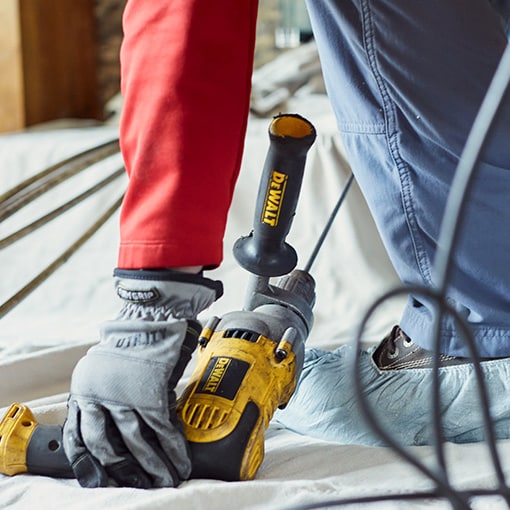
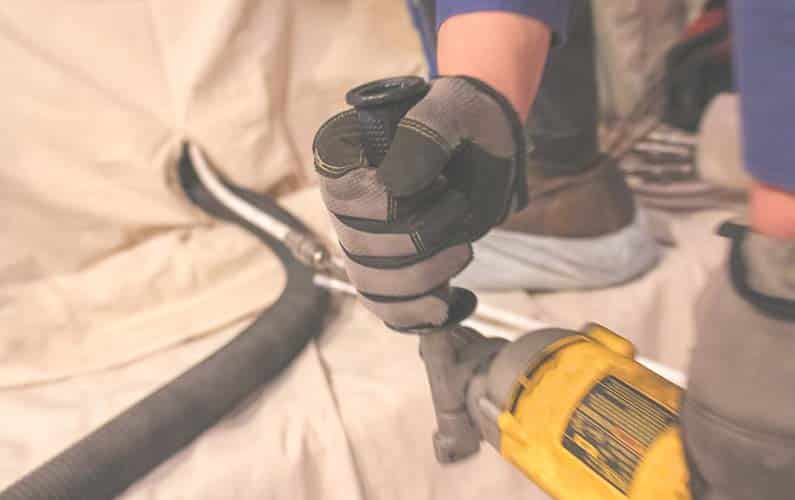
A few of the tools and equipment needed for proper cleaning
For more detailed information on the considerations involved with cleaning and chimney maintenance tips, check out this blog post.
How Often Should I Clean My Chimney?
Your chimney should be cleaned and inspected at least once a year according to the Chimney Safety Institute of America (CSIA) and other veteran professionals. It should also always be swept when any amount of glazed creosote is present.
Experts worldwide have told customers that exact statement a thousand times. And we’ll continue to say it because it’s an essential aspect of wood-burning and gas fireplace chimney maintenance. As a fireplace owner, you should follow this maintenance tip religiously.
Certified Sweep cleaning from the bottom
If you use a wood-burning fireplace year-round, your system may need cleaned 2 to 3 times per year. Of course, the more fires started, the more creosote that will be built-up. Spending a couple hundred dollars on inspections and cleaning is better than worrying about putting your family and home at risk.
Do Cleaning Logs Really Work?
While the CSIA gave their accepted product status to chimney cleaning logs, they don’t really work as an effective cleaner. It may sound great, but $15 cleaning logs are not, and never will be, a substitute for hiring a professional sweep.
Cleaning logs won’t properly clean your system, but that doesn’t mean they’re useless. As you can read more in our creosote sweeping blog, they can play a vital role in the chimney maintenance process. To minimize creosote follow these maintenance tips:
Burn wood with 15 to 25 percent moisture content
Follow manufacturer and technician instructions.
Utilize cleaning logs every few dozen fires.
SUGGESTED READING: We have an entire post dedicated to this if you’re interested to learn more.
Is it Okay to Leave a Gas Fireplace on All Night?
You should never leave a gas fireplace on all night. We understand that your fireplace provides warmth and comfort throughout the house, but it can quickly turn hazardous overnight.
Natural gas, propane, and wood-burning fireplaces produce a poisonous gas called carbon monoxide, commonly known as the silent killer. It’s a fatal gas that’s odorless, colorless, and can fill up a room in a hurry.
To ensure carbon monoxide safety, you need to educate yourself on direct vent, ventless, and insert run-time specifications. Those run-times vary mainly depending on the manufacturer’s instructions and local authorities having jurisdiction. But no matter what, never leave a fire running in an unattended room.
Gas Fireplace
You can become an expert on all things fireplaces, yet, accidents can still happen. Leaving your gas fireplace on overnight is a possible one. That’s why you need at least one smoke and carbon monoxide detector in a room where a fireplace is present.
What Causes a Furnace to Leak Carbon Monoxide?
If carbon monoxide is leaking through your furnace, that likely means that your heat exchanger is cracked.
A heat exchanger is a metal shield that distributes air from the furnace. When the furnace heats up, the metal shield expands. When the furnace cools down, the metal shield contracts. As this keeps happening over time, cracks can develop within the shield, causing carbon monoxide to leak out.
You can avoid potential furnace carbon monoxide leaks by scheduling annual inspections, replacing air filters, and checking your carbon monoxide detectors.FURNACE SERVICE
Can Your Chimney Catch Fire?
Chimneys can catch fire, and, unfortunately, they are far too familiar. Over 25,000 chimney fires happen per year. Many of which led to hundreds of thousands of dollars in damage to your home. Not only can they destroy your system, but they can also ruin your home. They truly epitomize why you should take chimney maintenance seriously.
These fires typically occur due to an abundance of creosote build-up or debris catching fire inside the flue. Restricted air, improperly seasoned firewood, and cool temperatures in the system encourage creosote build-up.
Other than chimney fires obviously being extremely destructive, a significant issue is that most of them go undetected. Check out this blog post to learn more about chimney fire warning signs.
Aftermath of a chimney flue fire
Summary
Hopefully, for those who made it through this blog, you now understand the severity of proper chimney maintenance. If you put off an oil change for too long, your engine will eventually run less efficiently, wear out, and possibly, break down. The same is true for maintaining your chimney. Putting off or finding quick-fixes for professional inspections and cleanings is extremely risky.
To summarize, if you frequently use your fireplace, wood-stove, or any other system, proper maintenance is key. And if you aren’t an expert technician, hire a certified professional to help maintain it. If you aren’t sure or confident about something, hire a professional. If you even lightly suspect an issue is occurring within your system, hire a professional. We promise that it’s not worth the risk!
At the most basic, fundamental level, an annual AC inspection and preventative maintenance visit should consist of:
Simple integrity tests for your thermostat, wiring, AC shutoff, and blower shutoff
Visual inspection of electrical components, tightening connections as needed
Visual inspection of supply registers and return vents, cleaning blockages as needed
Replacement of air filters at the return grilles or indoor unit
Cleaning/flushing of drain line plus visual inspection of drain pan and switch
Testing for all limit and safety controls
Cleaning and inspection of the condensate pump, if you’ve got one
Inspecting/testing capacitors and contactors, noting any corrosion or rust
Cleaning of the condenser coil
Visual inspection of all lines and coils paying particular attention to any disconnects within ten feet of the unit and the integrity of suction line insulation
Testing the compressor amp draw, condenser fan motor amp draw, and blower motor amp draw
Verification that the refrigerant charge meets manufacturer specifications
Checking the temperature drop across the evaporator coil
Testing the system’s static pressure to identify opportunities to improve airflow
Visual inspection of exposed ductwork for air leaks and kinks
If your AC inspection doesn’t include all of the above, it’s not a complete inspection.
At PV, our inspection does cover all of these maintenance, testing, and analysis tasks. You might have noticed that we include a lot of things that other HVAC contractors ignore. The static pressure test is particularly valuable since the results can help you extend the life of your equipment. Most don’t bother with it. We do, though.
Without an inspection this thorough, you might end up with a less-than-optimal AC and heating situation. We don’t want that, and neither do you.
So, how can you get the complete inspection this spring? By beginning a service agreement with PV! Every agreement includes two inspections per year plus a lot of valuable extras.
Service agreements are a win/win. Here’s why.
We like HVAC service agreements because they allow us to build long-term relationships and help people maintain safe, comfortable home environments. But it’s our clients who benefit the most. In addition to knowing that your HVAC equipment is operating at peak performance, you get extras like…
No service charges for maintenance performed as a result of inspection findings
15% discount on any type of repair
New 1″ filters for you to keep at home and change out every few months
10-year labor warranty when you have us install a new system
You get all of that plus the two yearly inspections – one for the cooling season and one for the heating season. It’s a $700 value, but our current price is just $189/year for one system plus $96 for additional systems.
It’s going to be a hot summer. Why chance it?
It’s not exactly going out on a limb to predict that this summer will be a hot one for Atlanta.
90+ degree highs, 90%+ humidity, sunshine, sweat, mosquitos… If you’ve lived here a while, you know how it goes.
The last thing you want is for some annoying problem – a busted capacitor, say – to get between you and your indoor comfort when it’s 95 degrees outside. Getting an AC inspection is like going to the dentist twice a year or getting your car serviced now and then. It’s preventative. And the easiest problems to solve are the ones that never become problems in the first place.
Assuming it’s done right, that’s exactly what your annual AC inspection offers: a comfortable, problem-free summer.
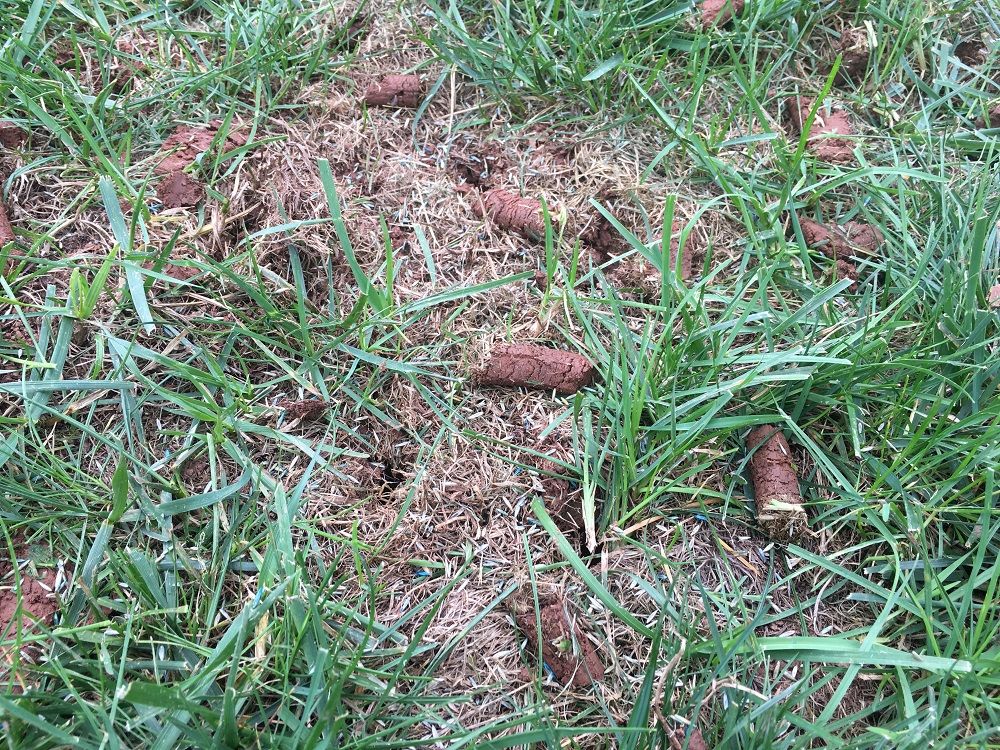
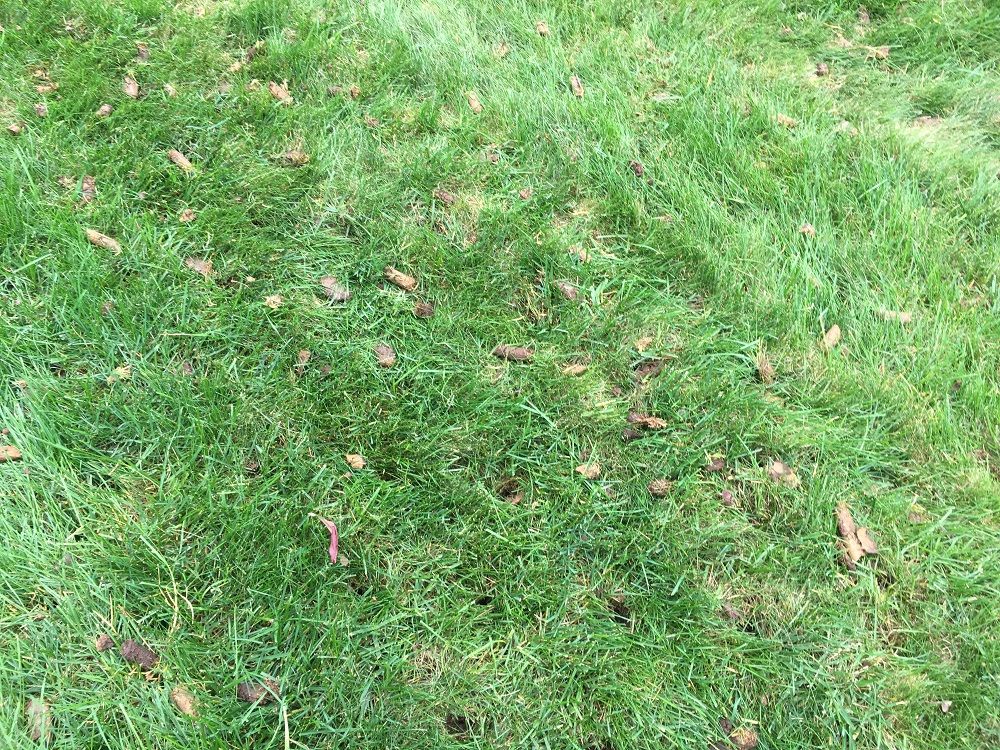
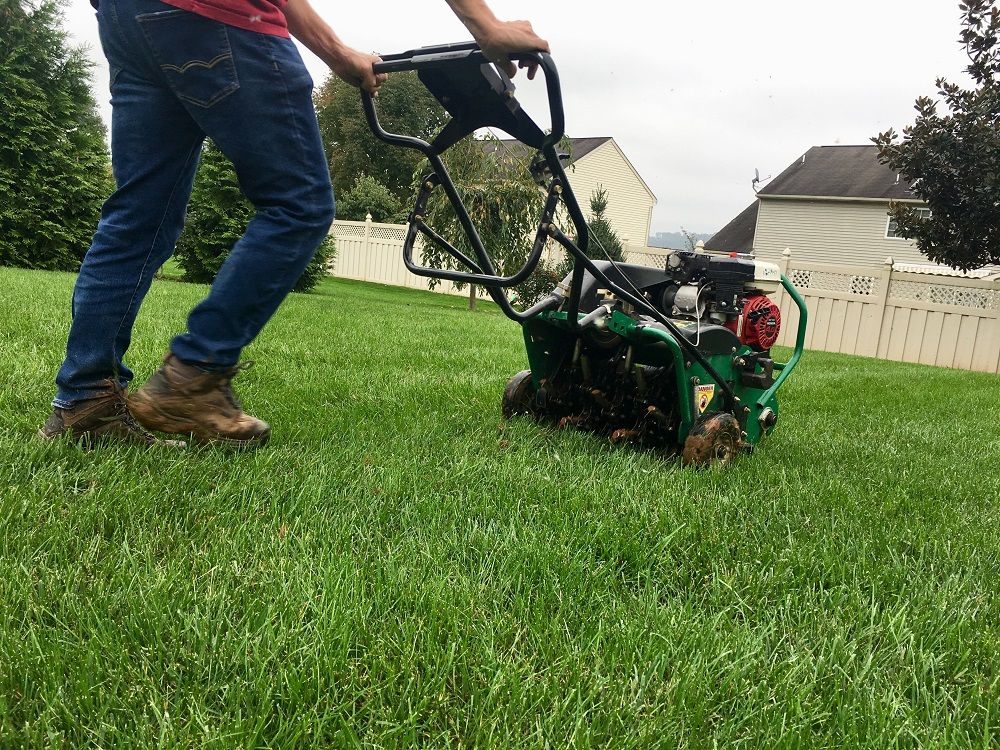
Aeration is the process of making holes throughout your lawn by pulling small soil plugs (called “cores”) with a special machine called a core aerator. By doing this, it allows more oxygen, water, and nutrients to penetrate deep into the soil and down to the root zone. That’s important because it creates a more favorable environment for the root system to grow. Healthier roots add up to a healthier lawn.
When Should You Aerate in Texas?
Aerating lawns in Texas can occur in both the spring and the fall. A lot of it has to do with the soil temperature. You don’t want it to be too hot or you’ll risk drying out the grassroots of your existing grass. However, the milder temperatures of both spring and fall make those seasons ideal.
If you were to only pick one, we’d recommend the spring, before entering the prime growing season. The loosened soil helps the fertilization that we apply in the spring to be more effective. When you apply fertilizer atop of clay-like soil, it just sits there.
Dallas and North Texas
Many lawn care experts in the Dallas-Fort Worth area advise that aeration service is most effective in the fall. Cooler fall temperatures prevent the ground from drying out after aeration, and there is less chance of a weed invasion after fall aeration than spring aeration. However, because many North Texas lawns are planted with warm-season grasses, spring aeration is also highly effective.
If you choose spring, aerate in April/May.
If you opt for fall, aerate in late-September through October.
How Often Should Aeration Be Performed?
As we mentioned, lawn aeration in Texas can be performed in both spring and fall, and many homeowners want it completed bi-annually in order to really maximize the benefit that they get out of this service.
However, at the very least, you should be having this service performed annually. Given our soil type, it’s too important to let more than a year pass without aerating. Any other service or efforts you make like watering or fertilizing are not going to be as impactful without well-aerated soil.
Who Should Perform Lawn Aeration?
Though some people attempt DIY aeration, this is a much more involved service than they often realize. The equipment that is typically available for rent is often clunky and has likely been overused. Oftentimes the equipment is also very heavy—a lot heavier than most people realize—and the task of doing a full pass over the yard is exhausting.
It’s more time-consuming and laborious than the average homeowner has bargained for. Plus, very few people really want to spend their time performing aeration on their own when they have better things to be doing.
And don’t forget to mark the sprinkler heads and any shallow lines before aerating! This is actually another pro to using a lawn aerating service from Grassperson as this important task is taken care of by us as part of the service.
Working with Grassperson for Texas Lawn Aeration
At Grassperson, lawn aeration is part of our fertilization and weed control service offering. Our goal is to take all of the burden off of your plate when it comes to achieving a great lawn, and lawn aeration is an essential part of that.
When professionally performed, aeration is going to allow your roots to get what they need to grow longer and stronger and that’s going to lead to overall healthier grass. However, when you don’t aerate, you end up with a shallow root system, and that’s going to lead to weakened grass.
If you truly want the best lawn on your block, then this is a service that simply cannot be overlooked. By investing in professional lawn aeration, you’ll be able to have that lush green lawn that you desire.
Ready to get the results that you desire for your lawn in the Flower Mound, Highland Village, or Lewisville, TX area? Get a free quote and then enjoy the best lawn with no worries!
I initially had reservations that a homemade method would not remove grime successfully or leave spots behind; however, my friend shared that she had experimented with a dish soap and vinegar solution, and the process was almost effortless. To begin, I mixed two cups of water with 1/2 teaspoon of dish detergent and 1/4 cup of white vinegar, enough to cover the windows at the front of my home. However, if you’re working with a particularly large surface area, then you may want to expand on this measurement to cater to your windows. After creating the solution, I proceeded to pour it into a spray bottle (I use this glass spray bottle from Amazon(opens in new tab)) before spraying it on the inside of my windows and using a sponge to wipe the liquid away. After this, I used a large microfiber cloth(opens in new tab) (also from Amazon) to rub the solution in a Z-shaped motion – to stop those notorious smears. View between the kitchen island and units towards the bi-fold doors to the garden with skylights overhead(Image credit: Jessica Buckley, Mary Wadsworth)After following this method inside, I did the same on my exterior window before observing the results, and I can say that I was very impressed. Both my interior and exterior windows were shiny and completely spotless – and I wondered why I had let myself wait so long before giving them the clean they needed. The entire process took no longer than 30 minutes – and I’ve already enjoyed the benefits of a clean window for weeks. And much like using baking soda to clean windows, I found I was able to use the ingredients in my every day – as both dish soap and vinegar and essentials in my daily cleaning routine. I was, inevitably, pleased with my results and was surprised that such a simple (and non-toxic) solution had achieved the cleanness I desired. Therefore, I sought the expertise of Corbin Mason-Smith, the owner of Superior Exterior Cleaning(opens in new tab), to see what makes the solution so powerful – and see if he had any tips to accentuate this window treatment idea further. Elegant white kitchen with cozy window seat, kitchen island with marble top, rounded glass pendant light, wooden flooring, white furniture and cabinets(Image credit: Paul Raeside)’Dishwashing soap is a key ingredient in a window cleaning solution,’ Corbin says. Before explaining how microfiber towels are best for wiping the frames and any streaks, should you leave any in the process? I tend to use 1/2 teaspoon of dish detergent, as suggested. However, the expert warns that you may need more if you are cleaning on a warmer day.’The amount of cleaning solution that will go on a window will depend on the weather. If it is a sunny day, then the glass will require more solution on it than if it is a cooler day,’ the expert says. He adds that when you are cleaning windows indoors, you should place an old bath towel at the base of the window to catch any excess solution.
Birthdays are the bomb—you can treat yourself to indulgences all day. There’s no guilt if you want to skip the gym or book back-to-back classes, if that’s your idea of the best day ever. Not to mention the fact that you get showered with gifts. Since we all love getting free treats, we scoured the internet for the best birthday deals from your favorite stores. Here’s what you can score during the month of your birthday.ADVERTISEMENT – CONTINUE READING BELOWhttps://e3d14a78ade25ed6e91df36798b75830.safeframe.googlesyndication.com/safeframe/1-0-38/html/container.html
American EagleTIM BOYLE//GETTY IMAGESADVERTISEMENT – CONTINUE READING BELOW
Sign up for Real Rewards and you’ll find a special birthday coupon in your inbox on your big day. Happy shopping!
MORE FROM WOMEN’S HEALTH
Everything to Know About Your Menstrual Cycle
PauseUnmuteEverything to Know About Your Menstrual Cycle
If you’re jonesing for a classic shopping mall treat, Auntie Anne’s has your birthday covered. Download the My Pretzel Perks app to score a free pretzel for your birthday.ADVERTISEMENT – CONTINUE READING BELOW
Aveda
MONICA SCHIPPER//GETTY IMAGES
With all the birthday festivities, make sure you book some time to relax. Aveda will gift you with a free nourishing oil, and if you sign up for the Pure Privilege rewards program, you’ll score double points on your next purchase. Let the pampering begin.ADVERTISEMENT – CONTINUE READING BELOW
bareMinerals
RANDY SHROPSHIRE//GETTY IMAGES
Get ready for some makeup goodies! Sign up for the Good Rewards program and you’ll get a free present. Depending on the time of year, it could be anything from a brush to a mini mascara and blush duo.ADVERTISEMENT – CONTINUE READING BELOW
Baskin Robbins
SMITH COLLECTION/GADO//GETTY IMAGES
If you sign up for a Baskin Robbins account online, you’ll score a spot in the Birthday Club. As a member, you can #treatyoself to a free scoop on your birthday.ADVERTISEMENT – CONTINUE READING BELOW
Ben & Jerry’s
JAMIE MCCARTHY//GETTY IMAGES
Join the Flavor Fanatics and you’ll get more free ice cream on your big day!ADVERTISEMENT – CONTINUE READING BELOW
Benefit
NICOLAS ASFOURI//GETTY IMAGES
To keep you feeling fabulous for your birthday, Benefit offers free brow arching at their U.S. Brow Bar locations. No purchase or rewards program necessary—just roll in anytime during your birthday week with a valid ID and walk out with well-groomed arches.ADVERTISEMENT – CONTINUE READING BELOW
Benihana
RON BULL//GETTY IMAGES
Free dessert on your birthday is pretty sweet, but a free dinner is even better. If you sign up for The Chef’s Table e-newsletter, you’ll get a $30 Benihana gift certificate to use anytime during the month of your birthday.ADVERTISEMENT – CONTINUE READING BELOW
Buca di Beppo
BRYAN STEFFY//GETTY IMAGES
If hibachi isn’t your thing, you can nab a free sundae during your birthday month if you celebrate at a Buca di Beppo location.ADVERTISEMENT – CONTINUE READING BELOW
Buffalo Wild Wings
THE WASHINGTON POST//GETTY IMAGES
Sign up for Blazin’ Rewards and you’ll score year-round deals—including six free wings during your birthday month to celebrate your big day.ADVERTISEMENT – CONTINUE READING BELOW
Burger King
PICTURE ALLIANCE//GETTY IMAGES
Download the app and sign up with your birthday. You’ll be treated to double rewards points (called “Crowns”) that you can redeem for menu items.ADVERTISEMENT – CONTINUE READING BELOW
Carvel
MEDIANEWS GROUP/READING EAGLE VIA GETTY IMAGES//GETTY IMAGES
Who doesn’t want a free cone on your birthday? All you have to do is sign up for the Fudgie Fanatics email list!ADVERTISEMENT – CONTINUE READING BELOW
Sign up for Chili’s rewards to get a free dessert on your birthday.ADVERTISEMENT – CONTINUE READING BELOW
Cinnabon
JEFF GREENBERG//GETTY IMAGES
Sign up for Cinnabon Rewards, and you’ll score a 16 oz cold brew on your big day.ADVERTISEMENT – CONTINUE READING BELOW
CVS
TIM BOYLE//GETTY IMAGES
Unfortunately, your birthday month doesn’t mean you can ditch running errands. But luckily, CVS makes it slightly more bearable when you sign up for ExtraCare Rewards—you’ll score three dollars in ExtraBucks Rewards on your b-day.ADVERTISEMENT – CONTINUE READING BELOW
Dairy Queen
ANDREW BURTON//GETTY IMAGES
Join the Blizzard Fan Club to get a treat on your special day.ADVERTISEMENT – CONTINUE READING BELOW
Del TacoDIANA HARONIS//GETTY IMAGESADVERTISEMENT – CONTINUE READING BELOW
If you’re in the mood for even more sweet treats, join the Dot Crazy Email Club for a free cup on your b-day.ADVERTISEMENT – CONTINUE READING BELOW
DSW
BRYAN BEDDER//GETTY IMAGES
DSW is a real birthday bestie, since, duh, you’ll be needing a new pair of shoes for your party. Sign up for the DSW VIP program and you’ll receive a $5 gift certificate to spend during your birthday month.ADVERTISEMENT – CONTINUE READING BELOW
Dunkin’ Donuts
TIM BOYLE//GETTY IMAGES
If Dunkin’ coffee is your favorite, the DD Perks rewards program offers free birthday java.ADVERTISEMENT – CONTINUE READING BELOW
Friendly’s
MEDIANEWS GROUP/BOSTON HERALD VIA GETTY IMAGES//GETTY IMAGES
Friendly’s is known for its ice cream, so it makes sense why your birthday freebie is a medium sundae. Just be sure to sign up for the Sweet Rewards Club!ADVERTISEMENT – CONTINUE READING BELOW
IHOP
JEFF GREENBERG//GETTY IMAGES
The OG pancake house will take care of any partied-too-hard birthday hangovers with a free stack of pancakes on your big day. Just sign up to be a part of the rewards program and pass the syrup.ADVERTISEMENT – CONTINUE READING BELOW
Jack in the Box
ULLSTEIN BILD//GETTY IMAGES
On your birthday, you’ll be treated to two free tacos with any purchase.ADVERTISEMENT – CONTINUE READING BELOWhttps://e3d14a78ade25ed6e91df36798b75830.safeframe.googlesyndication.com/safeframe/1-0-38/html/container.html
Jamba Juice
MEDIANEWS GROUP/BOULDER DAILY CAMERA VIA GETTY IMAGES//GETTY IMAGES
If you’ve signed up for Jamba Rewards and spent at least $15 on your account, you’ll score a free smoothie on your birthday to power you through a long day of festivities.ADVERTISEMENT – CONTINUE READING BELOW
Jersey Mike’s
MONKEY BUSINESS IMAGES//GETTY IMAGES
Join Jersey Mike’s email list and enjoy a free sub! Yum.ADVERTISEMENT – CONTINUE READING BELOWhttps://e3d14a78ade25ed6e91df36798b75830.safeframe.googlesyndication.com/safeframe/1-0-38/html/container.html
If you’re in the mood for fast food, you can’t go wrong with Mickey D’s. Download the app and enjoy a deal on certain menu items.
Moe’s Southwest GrillADVERTISEMENT – CONTINUE READING BELOWTHE WASHINGTON POST//GETTY IMAGES
Become a Moe’e Rewards member, and get a free burrito on your birthday. Who doesn’t want a free burrito?ADVERTISEMENT – CONTINUE READING BELOW
Panera Bread
DIANA HARONIS//GETTY IMAGES
Panera’s rewards program MyPanera knows how to treat you right on your big day. Present your rewards card on your birthday to get a free treat. ADVERTISEMENT – CONTINUE READING BELOW
Papa John’s
SMITH COLLECTION/GADO//GETTY IMAGES
Pizza is the ultimate birthday food, so why not order a pie on your special day? If you’re a member of Papa Rewards, you’ll get a free dessert.ADVERTISEMENT – CONTINUE READING BELOW
P.F. Chang’s
SCOTT OLSON//GETTY IMAGES
If you’re having a birthday dinner at P.F. Chang’s, be sure to get your free appetizer or dessert. All you need to do is join the restaurant’s rewards program.ADVERTISEMENT – CONTINUE READING BELOW
Pinkberry
MEDIANEWS GROUP/BOSTON HERALD VIA GETTY IMAGES//GETTY IMAGES
Pinkcard holders can treat themselves to a free birthday yogurt.ADVERTISEMENT – CONTINUE READING BELOW
Add your birthday when you create an account, and the store promises to send you a “birthday surprise“—whether it’s a coupon or a free gift, it’s sure to be a treat!
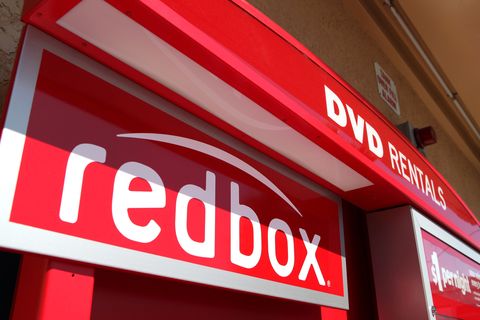
If staying in and watching guilty pleasure movies is your idea of birthday #goals, this one is for you. Sign up for Redbox’s rewards program and you’ll get a free one-night birthday rental.
Who doesn’t love pizza? Join the Slice Society and you can probably guess what your birthday freebie will be.
Sephora
MARIO TAMA//GETTY IMAGESADVERTISEMENT – CONTINUE READING BELOW
Sephora delivers big on birthday beauty. If you’re a member of their Beauty Insider program (which is free to join) you’ll get a deluxe set of mini samples to help make sure your birthday look is fire.
Sonic
SCOTT OLSON//GETTY IMAGESADVERTISEMENT – CONTINUE READING BELOW
Sign up for MySonic rewards and you’ll get to choose between a few goodies for your birthday treat.
You can’t start your b-day without your go-to drink. If you’re a Starbucks Rewards member you’ll get a free drink (or treat!).
Steak ‘n ShakeADVERTISEMENT – CONTINUE READING BELOWJEFF GREENBERG//GETTY IMAGES
Join the Steak ‘n Shake Rewards Club and you’ll get a free treat on your birthday, plus a $5 reward for every $50 spent.ADVERTISEMENT – CONTINUE READING BELOW
Subway
PICTURE ALLIANCE//GETTY IMAGES
“Eat Fresh” on your birthday with a cookie if you sign up for MyWay Rewards.ADVERTISEMENT – CONTINUE READING BELOW
T.G.I. Friday’s
BRUCE BENNETT//GETTY IMAGES
T.G.I. your birthday. Join Friday’s Rewards and get yourself a free dessert.ADVERTISEMENT – CONTINUE READING BELOW
Ulta
JEFF GREENBERG//GETTY IMAGES
Ulta helps you stay glammed up with a free gift on your birthday. Sign up for the Ultimate Rewards program to access the perk, plus score double points on all purchases made during your birthday month.ADVERTISEMENT – CONTINUE READING BELOW
Waffle HousePATRICK T. FALLON//GETTY IMAGESADVERTISEMENT – CONTINUE READING BELOW
Macaela MacKenzie is a journalist covering women’s equality. Her work focuses on sports, the gender gap across industries, and breaking down stigmas in women’s health. She has over 2,000 bylines for outlets including Glamour, Marie Claire, Elle, Women’s Health, SELF and Forbes. She’s currently working on her first book on women’s equality in sports. JANAYA WECKERLIFESTYLE EDITORJanaya is a Lifestyle Editor for Hearst Magazines. When she’s not writing, you can find her bringing out her inner Taylor Swift on the guitar, reading scary novels — but drawing the line at scary movies! — and adding lots of sugar to her iced coffee (yes, even in the winter), because life can never be too sweet.
next to Jack in the Box, near Sherwin-Williams Paint
Saturday from 9:00 AM to 12:00 PM
Upcoming Dates in 2022
September 24th
October 22nd
November 19th
December 17th
Dog Vaccinations
Programs supporting regular vaccination of dogs have contributed both to the health of dogs and to public health. In countries where routine rabies vaccination of dogs is practiced, for example, rabies in humans is reduced to a very rare event. Vaccinating your dog can lead to a longer, healthier life at little cost to you.
Flea and Heartworm Prevention Available
Rabies vaccinations are required by law
Canine Flu: Dog Influenza, respiratory infection, highly contagious and very deadly.
4-Way Leptospirosis: Vaccine for 4 Serovars (increase in disease)
DHL+PP: Distemper Parvo Combo
D (Distemper virus): causes respiratory and nervous system disease, #1 cause of death
H (Hepatitis virus): causes liver damage
Leptospirosis: Bacterial disease causes kidney and liver failure and blood in the urine. Very deadly, and transmitted between humans and dogs.
Parainfluenza Virus: Respiratory infection, hacking, and coughing.
Parvo Virus: #2 cause of puppy death, vomiting, Diarrhea, and bloody stools.
Bordetella: Bacteria that cause kennel cough
Lymes: Tick-transmitted disease contagious to dogs and people
Toy Breeds
We recommend all Toy Breeds to be given a 1-inch strip of Nutrical Gel Supplement four times per day to prevent low blood glucose levels. Toy Breeds are highly susceptible to hypoglycemia, which can result in low life expectancy.
Prices are subject to change without notice.
Dog Tests and Services
By testing your dog for ailments, you can potentially find something wrong and treat it. Dogs who undergo routine testing are less likely to die of preventable diseases.
Prices are subject to change without notice.
OSHA
$3.00
AGE (plus $10 tech fee)
$19.00
Fecal Test (bring fresh sample)
$18.00
Deworming
$10.00-$40.00
Heartworm Test
$20.00
4DX Test
$37.00
Skin Scrape (with minor)
$20.00
Toenail Trim (plus $10 tech fee)
$10.00
Minor Exam
$30.00
REMEMBER, ALWAYS MICROCHIP YOUR PETS!
It helps you protect your pet and prevent accidental Euthanasia at Animal Control!









 TIM BOYLE//GETTY IMAGESADVERTISEMENT – CONTINUE READING BELOW
 EDUCATION IMAGES//GETTY IMAGESADVERTISEMENT – CONTINUE READING BELOW
 SOPA IMAGES//GETTY IMAGES
 MONICA SCHIPPER//GETTY IMAGES
 RANDY SHROPSHIRE//GETTY IMAGES
 SMITH COLLECTION/GADO//GETTY IMAGES
 JAMIE MCCARTHY//GETTY IMAGES
 NICOLAS ASFOURI//GETTY IMAGES
 RON BULL//GETTY IMAGES
 BRYAN STEFFY//GETTY IMAGES
 THE WASHINGTON POST//GETTY IMAGES
 PICTURE ALLIANCE//GETTY IMAGES
 MEDIANEWS GROUP/READING EAGLE VIA GETTY IMAGES//GETTY IMAGES
 TASOS KATOPODIS//GETTY IMAGESADVERTISEMENT – CONTINUE READING BELOW
 JEFF GREENBERG//GETTY IMAGES
 JEFF GREENBERG//GETTY IMAGES
 TIM BOYLE//GETTY IMAGES
 ANDREW BURTON//GETTY IMAGES
 DIANA HARONIS//GETTY IMAGESADVERTISEMENT – CONTINUE READING BELOW
 BRIAN ACH//GETTY IMAGES
 BRYAN BEDDER//GETTY IMAGES
 TIM BOYLE//GETTY IMAGES
 MEDIANEWS GROUP/BOSTON HERALD VIA GETTY IMAGES//GETTY IMAGES
 JEFF GREENBERG//GETTY IMAGES
 ULLSTEIN BILD//GETTY IMAGES
 MEDIANEWS GROUP/BOULDER DAILY CAMERA VIA GETTY IMAGES//GETTY IMAGES
 MONKEY BUSINESS IMAGES//GETTY IMAGES
 JUSTIN SULLIVAN//GETTY IMAGESADVERTISEMENT – CONTINUE READING BELOW
 EDUCATION IMAGES//GETTY IMAGESADVERTISEMENT – CONTINUE READING BELOW
 JOERG KOCH//GETTY IMAGESADVERTISEMENT – CONTINUE READING BELOWhttps://e3d14a78ade25ed6e91df36798b75830.safeframe.googlesyndication.com/safeframe/1-0-38/html/container.html
 THE WASHINGTON POST//GETTY IMAGES
 DIANA HARONIS//GETTY IMAGES
 SMITH COLLECTION/GADO//GETTY IMAGES
 SCOTT OLSON//GETTY IMAGES
 MEDIANEWS GROUP/BOSTON HERALD VIA GETTY IMAGES//GETTY IMAGES
 SOPA IMAGES//GETTY IMAGESADVERTISEMENT – CONTINUE READING BELOW
 RICH FURY//GETTY IMAGESADVERTISEMENT – CONTINUE READING BELOW
 JUSTIN SULLIVAN//GETTY IMAGESADVERTISEMENT – CONTINUE READING BELOW
 UCG//GETTY IMAGESADVERTISEMENT – CONTINUE READING BELOW
 JUSTIN SULLIVAN//GETTY IMAGES
 JEFF GREENBERG//GETTY IMAGES
 ALEX WONG//GETTY IMAGESADVERTISEMENT – CONTINUE READING BELOW
 MARIO TAMA//GETTY IMAGESADVERTISEMENT – CONTINUE READING BELOW
 SCOTT OLSON//GETTY IMAGESADVERTISEMENT – CONTINUE READING BELOW
 SAUL LOEB//GETTY IMAGESADVERTISEMENT – CONTINUE READING BELOW
 JEFF GREENBERG//GETTY IMAGES
 PICTURE ALLIANCE//GETTY IMAGES
 BRUCE BENNETT//GETTY IMAGES
 JEFF GREENBERG//GETTY IMAGES
 PATRICK T. FALLON//GETTY IMAGESADVERTISEMENT – CONTINUE READING BELOW


